Current developments TA2 – SmartLab
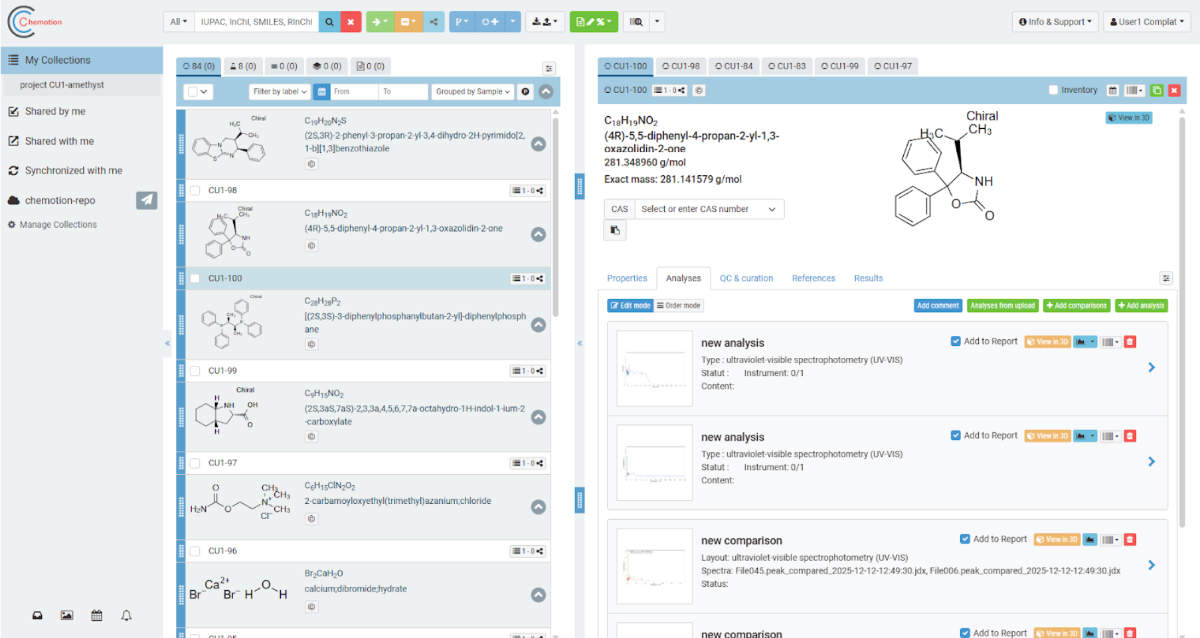
The Chemotion ELN electronic laboratory environment is getting new technical features and undergoing a revamp in terms of UI and UX aspects. The changes listed below will be included in versions 2.2 (November 2025) and 3.0 (December 2026 – availability via CLI at the end of January 2026).
Version 2.2: Version 2.2 comes with many technical changes and corrections to versions 2.0 and 2.1. Changes in terms of functions include the entities Cell Lines and Generic Elements, which have been supplemented by the option of splitting (generating child entries) and support for the export of large data collections.
Version 3.0: The chemical drawing programme ketcher-rails is being replaced by the official version of Ketcher. The first milestone in improving the user interface with a redesign of the three main levels is now available. Chemical mixtures can be individually compiled and used in reaction schemes like regular samples. Proteins can be recorded using the new entity for sequence-based macromolecules (SBMM) in comparison with external databases (currently supported: UniProt). Reactions can now also be configured using mass equivalents (wt %) and are supported by an extension of the variation definition functions. The work is complemented by an extension of the functions in the LabIMotion area. Among other things, flexible links between entities are supported, including in the area of data description for analyses (e.g. linking device descriptions).
Planning Version 4.0: Version 4.0 marks another milestone in the renewal of user guidance with further improvements to the UI. This is complemented by a revision of the ELN’s project management (collection management). A new sample type for heterogeneous materials has been defined for applications in inorganic and technical chemistry and can be tested by interested parties.
Current developments TA3 – Repositories
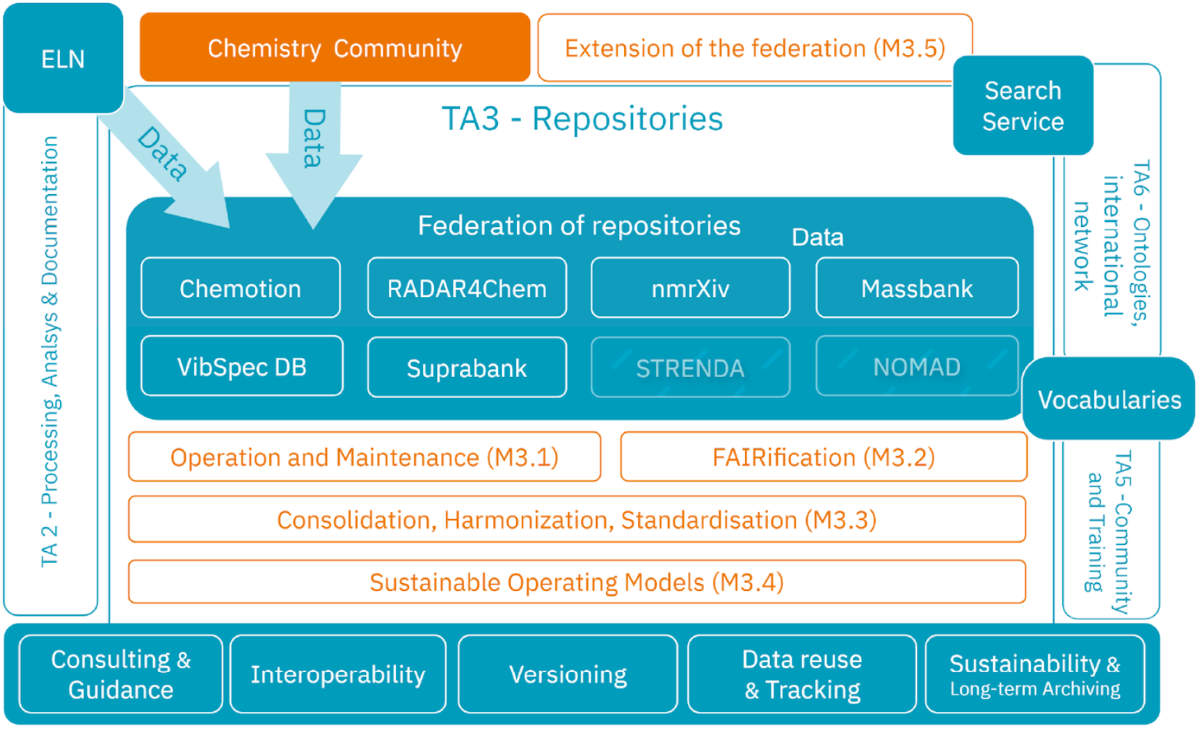
Current work within the infrastructure initiatives focuses on the further development of central chemical research data services and their seamless networking. An important focus is on RADAR4Chem, which has been fully connected to the TS4NFDI terminology service. This makes standardised vocabularies available directly in the metadata editor, including automatic term suggestions and ontology links. Advanced filter options for “keywords” and “ontology” increase findability, while enriched metadata facilitates integration into knowledge graphs.
The Chemotion Repository is undergoing extensive functional development with updates from versions 2.4.0 to 2.5.0. This includes a revised review and author management system, improved metadata support (including ORCID, ROR, RDF, DataCite 4.6), optimised export functions and numerous UX improvements. At the same time, functions are being introduced that enable the transfer of data to the nmrXiv repository and metadata to the Data Federation Tracker. Both aim to enable closer coupling between NFDI4Chem repositories as federated services in the future. To facilitate data preparation, SmartAdd was developed, a locally used browser tool for importing, visually organising and structurally preparing chemical data sets. ZIP archives can be imported via drag-and-drop, samples, reactions and analyses can be customised via a UI and then downloaded in a Chemotion-supported schema for import into Chemotion (repository or ELN). Direct transfer to the repository is also supported.
In the field of NMR data, nmrXiv and NMRium have been functionally expanded: nmrXiv offers improved security mechanisms, new integration interfaces and additional analysis modules. NMRium now supports multiple inset displays, flexible customisation and direct links between 1D and 2D spectra.
In the field of mass spectrometry, new publications have been made available on the MassBank platform, including an integrated record validator and expanded curation activities. Each version is archived with a DOI and kept available long-term to ensure reproducible use.