Electronic Lab Notebooks ELN
Electronic lab notebooks (ELNs) enable researchers to enrich experiments with extensive metadata and make the collected data traceable and reusable. The direct transfer of measuring devices to the ELN makes it the central repository for all data, which can then be easily published in repositories and transferred to long-term archives.
NFDI4Chem helps you find the right ELN, test it and implement it in your research environment.
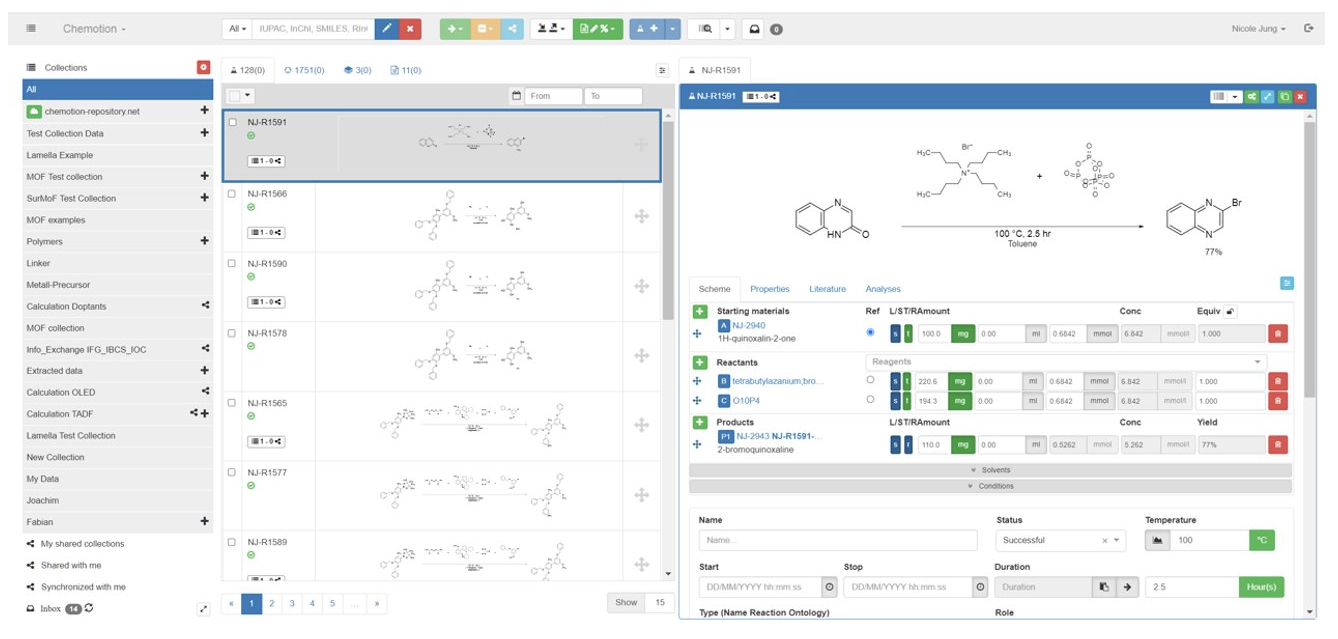
What are your benefits of an ELN?
- Everything in one place
Experiment descriptions, measurement data and other information can be directly linked to one another. - Less data loss
Centralised storage, access control and backups protect your research data. - Knowledge is preserved
Documented experiments and data remain accessible and understandable, even for new members of a research group. - Better prepared for publication
Structured metadata facilitates the transfer of data to repositories and supports the FAIR principles.
Which ELN is right for me?
| I’d like to try out an ELN first. A trial environment offers the opportunity to familiarise yourself with different ELN solutions and assess their features for your own work. → Try out ELNs |
| I would like to select an ELN for my research group. Different ELNs offer different features, integration options and operating models. The ELN Finder helps you compare different systems. → Go to the ELN Finder |
| I would like to run an ELN for my institution. For universities and research institutions, centrally managed ELN instances can be a way of supporting multiple research groups collectively. → ELNs at German universities |
| I would like to run my own ELN. There are various options for a self-hosted installation – ranging from local operation to hosted solutions. → Set up your own ELN |
How does NFDI4Chem support ELNs?
NFDI4Chem supports researchers in selecting and using ELNs – and is itself developing the Chemotion ELN, an open solution tailored to chemical research.
- Guidance: The ELN Finder allows different systems to be compared on the basis of relevant criteria.
- Trying them out: Various ELN solutions can be tested in practice.
- Chemotion ELN: NFDI4Chem is continuing to develop the open-source ELN Chemotion in collaboration with the community, incorporating requirements from chemical research.
- FAIRe research data: Chemotion ELN supports the structured collection and reuse of chemical research data.
ELNs, standards and repositories
An ELN is more than just a digital laboratory notebook: it can lay the foundations for chemical research data to be documented in a structured manner, described using appropriate standards, and made available for long-term reuse.
Chemotion ELN, like other ELNs, supports the structured recording of chemical experiments and research data. Standards ensure that information is described in a consistent manner and can be exchanged between systems. Finally, repositories provide the place where data is published, archived and made available for reuse.
This is how ELNs, standards and repositories interlink: from structured documentation in the laboratory, through standardised description, to the publication and reuse of research data.
More Info
- Dive deeper in our knowlegde base
News around ELN
 Chemotion ELN 3.0.0 Released - A whole range of new features make working with the new release easier.
  Research data management for all - The article reports on the experiences gained with the introduction of an ELN at the University of Würzburg.
  Developments SmartLab & Repositories - News from our tools - the next steps with our ELN and Repositories.
  Sustainable research through digital lab environments - New Podcast by Nicole Jung and Joachim Richert