Task Areas
In our first funding phase starting in 2020, we focused on molecules. This (and our key objectives) was the result of numerous workshops, discussions and surveys within the chemical community.
Key insights can be summarised as follows:
- Institutional Research Data Management poorly implemented.
- Electronic Laboratory Notebooks ELNs and LIMS for early capture of (meta) data in electronic form are desired but rarely used.
- Scientists in chemistry like to re-use data but rarely share their data.
- The concept of electronic metadata annotations are poorly understood and rarely used.
- Training in basic principles of RDM, covering the data workflow from the bench via repositories to peer-reviewed publications as well as basic concepts such as FAIR principles, is urgently needed.
With the start of the second funding phase in October 2025, we can see that improvements have been made in all areas. However, these are not yet satisfactory. In addition, developments have taken place over the past five years that we want to take into account by realigning our focus:
- The development of AI is only possible with machine-readable, standardised data. The expansion of this technology requires continuous optimisation of the data infrastructure.
- Reuse is an essential benefit of published data. To this end, we promote cultural change through the comprehensive and tailored teaching of data literacy. We provide technical support to researchers through standardisation and AI-supported analyses.
- Our digital laboratory environment enables seamless data flows and interdisciplinary applications.
This has not fundamentally changed the structure of our six task areas (TA).
The Areas
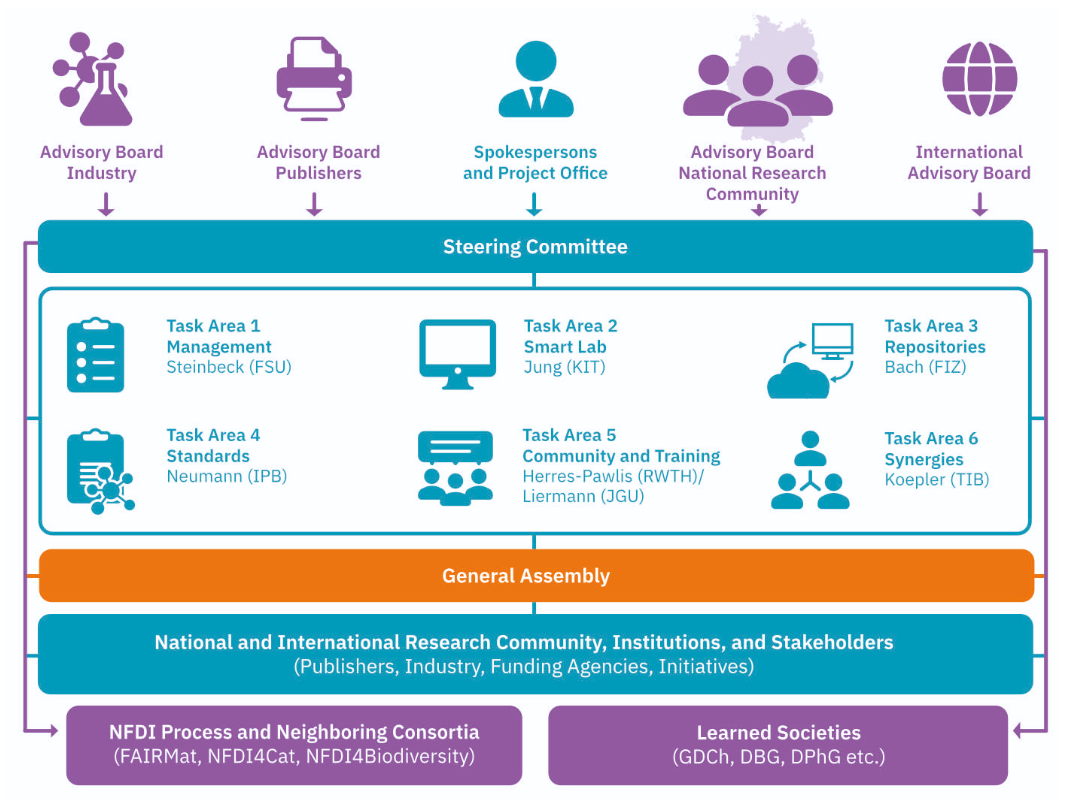
TA1 Management and Coordination ensures the lean and efficient financial and organisational management of the project.
TA2 Smart Laboratory (Smart Lab) focuses on the implementation and adaptation of existing and development of so far missing IT components embedded in a flexible work environment, necessary to capture data early in the life cycle and to further manage, analyse and store associated information. TA2 enables a digital change in chemistry by supporting scientists with digital infrastructure of tools, services and repositories interoperable within the NFDI infrastructure.
TA3 Repositories enables the reliable storage, dissemination and archival of all relevant research data at each stage of the data lifecycle. This includes raw data in diverse formats as well as curated datasets. TA3 will adapt major existing chemistry repositories and databases to FAIR principles and technical standards for metadata and interfaces, thus fostering interoperability and FAIRness as well as facilitating storing, disclosing, searching and re-using research data across distributed data sources.
TA4 Metadata, Data Standards and Publication Standards creates and maintains the specification and documentation of standards required for archival, publication and exchange of data and metadata on molecule characterisation and reactions, together with reference implementations and data validation. Ontologies are used where possible, and missing terminological artifacts are added.
TA5 Community Involvement and Training interfaces between community and infrastructure units: the community’s requirements are collected, analysed and channeled. Equally, dissemination and training on all levels are organised, starting in early undergraduate studies, and discipline-specific training material is developed. TA5 also fosters the awareness of the community for RDM and offers incentives for innovations.
TA6 Synergies coordinates the activities of NFDI4Chem within the NFDI association and the other NFDI consortia. TA6 is responsible for the coordination of the cross-cutting topics, including cross-domain metadata standards, semantic data annotation for cross-domain mapping of ontologies, provision of the Terminology Service as well as legal aspects of FAIR RDM. Harmonisation will be sought by working with international bodies such as the Research Data Alliance (RDA) and the International Union of Pure and Applied Chemistry (IUPAC). TA6 develops an overarching Search Service and Terminology Service, that both will be included into the NFDI infrastructure.