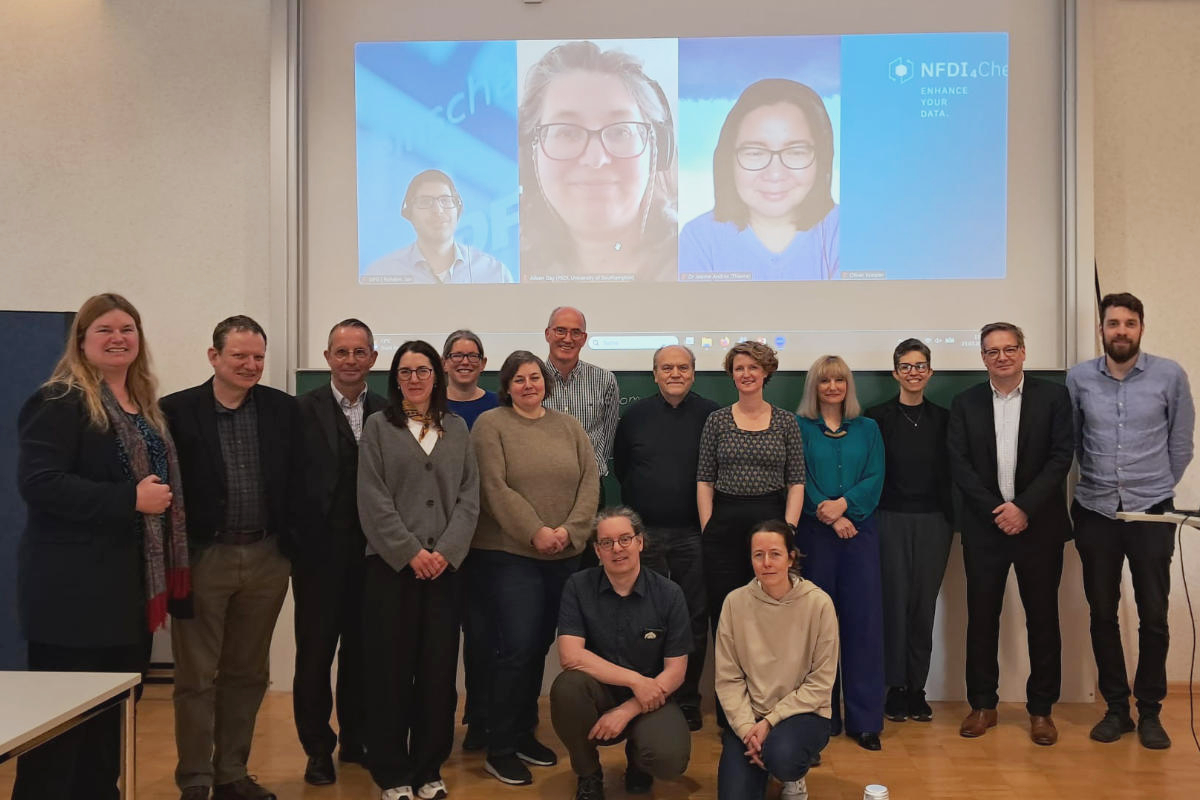
On March 23 & 24, 2026, NFDI4Chem held the third Editors4Chem meeting in Aachen, bringing together representatives from research organisations, publishing houses, and data‑infrastructure initiatives to discuss how research data can become an integral part of chemical publishing. Participants included IUPAC, CODATA, the Physical Sciences Data Infrastructure (PSDI), the Royal Society of Chemistry, the Cambridge Crystallographic Data Centre (CCDC), the Beilstein Institute, the German Research Foundation (DFG), and the academic publishers Thieme, Wiley‑VCH, and Springer Nature.
The workshop pursued two intertwined goals: First, to assess the current state of chemical publishing; second, to draft enforceable, FAIR‑compliant data‑deposit mandates—complete with a timeline and clear steps—that will require data publication alongside every submitted article. The insights gathered will be documented in a joint memorandum that aims to become a reference for open and responsible data practices in chemistry.
Previous Editors4Chem Workshops
The third meeting built on the experience of the earlier editions. The inaugural workshop in 2021 introduced the concept of data‑centred publishing and highlighted the potential benefits of open data (summary: https://nfdi4chem.de/1st-editors4chem-workshop). The second workshop (2023) moved from ideas to practice, presenting pilot projects on structured data formats and early validation tools for reviewers (summary: https://nfdi4chem.de/2nd-editors4chem-workshop). Both events demonstrated that the necessary technical infrastructure – data repositories, metadata standards, and interoperability frameworks – is already in place, but that a broader cultural shift is still required.
Day 1 – Current Situation and Cultural Challenges
Discussions on the first day confirmed that the technical foundations for FAIR‑compliant data publication are largely established. General‑purpose repositories (e.g., Zenodo, figshare) as well as discipline‑specific platforms (e.g., Chemotion, RADAR4Chem) already support the storage and dissemination of datasets with persistent identifiers. Standardised metadata schemas are also available.
Nevertheless, participants identified a significant cultural barrier. Many researchers perceive data deposition as an additional administrative burden rather than a long‑term investment. The German Research Foundation (DFG) presented its “Good Research Practice” guidelines, which include the deposition of project results as FAIR data. In addition, the advantages of FAIR data for researchers such as greater visibility, improved citation potential, and easier reproducibility were discussed. Yet, uptake across the community remains uneven.
In response, the attendees began drafting a joint memorandum that will set out shared principles for open, responsible data in chemistry. The draft is intentionally open‑ended; additional publishers and interested parties are explicitly invited to join the discussion and contribute to its final form.
Day 2 – Technical Implementation Within the Publication Workflow
The second day focused on concrete tools that can be embedded into the author‑review‑publication pipeline. Participants showcased automated validation pipelines that check whether submitted datasets fulfil the FAIR criteria, examining file formats, metadata completeness and interoperability with existing standards. New submission portals were demonstrated, allowing authors to upload raw data directly from laboratory information‑management systems (LIMS) or simulation software while capturing the required metadata automatically. For reviewers, prototype analysis and visualisation tools were presented, enabling a rapid assessment of data quality and reproducibility.
The outcomes of these technical sessions will be incorporated into the memorandum, providing concrete, actionable recommendations for publishers and research institutions.
Outlook
The chemical research community already possesses the technical means to publish data in a FAIR‑compliant manner. The remaining challenge is to foster widespread cultural acceptance and to embed the developed tools into everyday publishing practice.
The joint Memorandum of Understanding of FAIR data publishing in Chemistry, which will be published in the coming months, is intended to serve as a reference for publishers, research organisations, and funding bodies. All interested publishers and data‑infrastructure providers are welcome to join the initiative and help shape the emerging standards.
By working together, the chemistry community can set a global example for transparent, interoperable and reproducible scientific publishing.
More:
The Future of Chemical Publishing: From Vision to Standard - Third Editors4Chem meeting to discuss how research data can become an integral part of chemical publishing.  2nd Editors4Chem Workshop - This workshop is part of the holistic strategy of NFDI4Chem to increase the uptake of FAIR data publishing in chemistry by interfacing with the academic publishers.
  Author Guideline Landscape - The survey shows that publishers and journals are starting to include aspects of research data sharing in their guidelines.