90 participants (project members and guests) accepted our invitation to the NFDI4Chem Consortium Meeting 7.0, which took place in Jena on 12 and 13 May 2026. The main topic was on the further development of our services during the second funding period. The focus was on data-driven workflows, the integration of AI methods, the further development of interoperable infrastructures, and closer collaboration with other consortia.
Following the opening of the Consortium Meeting by Prof. Andreas Marx, President of the University of Jena, Kevin Jablonka kicked off the presentations with a keynote addressing data-driven methods in materials research. In particular, the discussion centred on the capabilities of large language models in extracting and interpreting chemical information from the literature. It became apparent that, thanks to internal consistency mechanisms, models can deliver results comparable to or better than those of humans in certain tasks; however, they remain susceptible to systematic misinterpretations and do not yet master chemical logic. Domain-specific knowledge therefore remains necessary, particularly for evaluating model results and defining meaningful constraints in the search space (e.g. through hard and soft constraints).
Reports from the Task Areas
TA2 reported on the current state of implementation, the uptake of Chemotion ELN, and further plans. Progress has been made in terms of domain coverage, AI-supported development, and new elements such as enzymes, devices and vessels.
TA3 provided an overview of the Federation’s repositories. Plans include expanding operational functions, further FAIRification, harmonising the repositories, developing service operation models and expanding the Federation.
For TA5, the focus was on the work plan up to 2028. This includes continuing community activities at conferences, expanding social media activities, and further diversifying the workshop programme. The aim remains to provide workshops and up-to-date teaching materials for all researchers, lecturers and students in the field of chemistry, including new train-the-trainer concepts. Furthermore, international activities such as the further development of InChI (International Chemical Identifier) and collaboration with the ECTN will be continued.
TA1 provided an update on the status of the federal-state agreement, success metrics, and progress and obstacles in the introduction of the Noco-DB as a central information tool.
TA4 and TA6 presented a joint report. The focus was on developments regarding MiChIs, ontologies and standards. The new ChemDCAT-AP was given particular attention. Internationally, we are very well integrated through Editors4Chem, Ontologies4Chem and the Workshop Series on sustainable digital chemical data standards.
Bernhard Sabel’s evening lecture (a recording of which can be found on YouTube) highlighted the challenges facing the scientific publishing system, particularly the growing influence of fake publications and ‘paper mills’. The discussion made it clear that transparent data, traceable workflows and new forms of quality assurance should play a key role in safeguarding the integrity of science.
Workshops
The importance of standardised data models for the reusability of chemical data was already highlighted in the pre-workshop. Using EnzymeML as an example, it was demonstrated how structured exchange formats enable a FAIR-compliant description of enzyme-catalysed reactions. Challenges remain, in particular, non-machine-readable literature data, heterogeneous metadata and inconsistent nomenclature. New approaches, such as LLM-supported tools for transforming raw experimental data into structured formats (e.g. JSON), highlight the potential of automated data processing, but require consistent data models.
On the second day, the workshop “Man or Machine: Who should the NFDI4Chem repositories serve?” focused on the use of data by humans and/or machines. The consensus was that data input processes must be designed to be accessible and research-oriented, whilst output interfaces should increasingly be API-based and machine-readable.
In the second workshop, “Plant a seed: How can we spread the idea of ‘FAIR data’ across Germany?”, creative approaches were discussed to widely communicate existing tools and services and to promote a cultural shift towards FAIR data management. Proposals aimed to promote research data literacy through both top-down and bottom-up approaches, to launch specific social media campaigns (e.g. ‘Tool Tuesday’), incentive schemes or the appointment of mandated NFDI ambassadors.
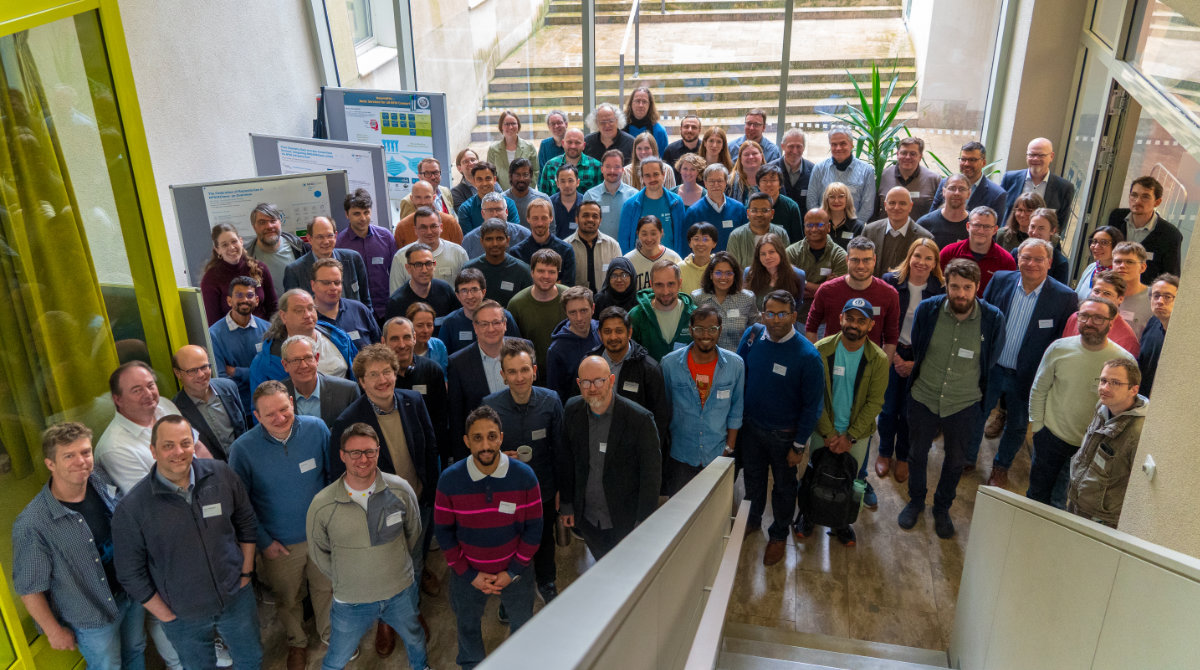
Picture: CC-BY-SA Kohulan Rajan
Inter-consortium meeting
In addition, NFDI4Chem invited other NFDI consortia in the natural and life sciences with a chemistry focus to an inter-consortium workshop. The topic this two-hour workshop was on mapping the services and activities of the seven consortia present. In the process, numerous potential synergies and future collaborative projects were identified: services whose user base could be extended to the communities of other consortia; tools from different consortia that could be effectively integrated; and similar activities that should be pooled, particularly in the area of community support. The workshop marked the start of further discussions and collaboration between the consortia.
Meeting with the advisory boards
During the consortium meeting, a meeting was also held with the advisory boards and a representative of the DFG. Among other things, discussions focused on how NFDI4Chem can address requirements in digital data management within the chemical industry and incorporate these into training programmes and measures to modernise chemistry degree programmes. Another key topic was the cultural shift that is now taking hold within the community after five years of NFDI4Chem.