The Technical InChI Meeting on Molecular Inorganics and Stereochemistry was held at RWTH Aachen University on June 1 and 2, 2026. The event gathered experts from academia, industry, software development and the InChI Trust, with participants traveling from Europe, North America and New Zealand to address one of the most demanding challenges in chemical representation: The reliable encoding of inorganic compounds and their stereochemistry within the InChI framework.
During the two‑day workshop significant progress was made toward the upcoming beta release of the molecular‑inorganics bond‑handling implementation. Core drawing conventions and bond‑disconnection rules were agreed upon, providing a solid foundation for the new functionality. Several long‑standing edge cases, such as ferrocene, Zeise’s salt, metal hydrides and multinuclear coordination systems, were resolved, removing major obstacles for future InChI specifications.
A major focus of the meeting was the development of a robust stereochemical framework for inorganic molecules. Discussions covered 2.5‑D representations, spherical coordination geometries, hapticity concepts and the potential addition of new stereochemistry layers. Proposals extending double‑bond stereochemistry encoding and improving the handling of stereochemical uncertainty were accepted, enhancing the expressive power of InChI for complex structures.
Strategic topics included the broader roadmap for InChI development, specification processes, testing requirements and preparations for forthcoming releases. The meeting also highlighted the growing ecosystem of tools that support InChI work, presenting prototype visualisation and interpretation software designed to increase transparency and usability for the wider chemistry community.
The new features can be tested here.
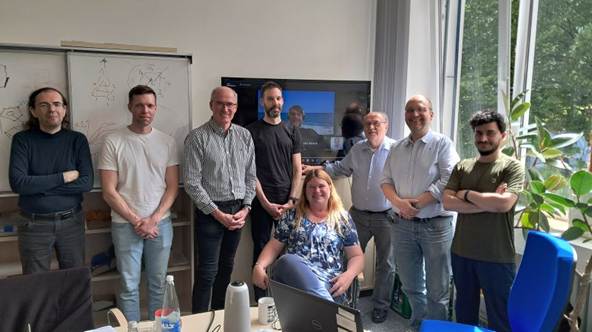
The contributions of the participants – Djordje Baljozovic, Felix Bänsch, Nauman Ullah Khan, Jan Brammer, Markus Nietfeld, Ulrich Schatzschneider, Christoph Müller, Gerd Blanke, Richard Hartshorn, Jonathan Goodman, Andrey Erin and Sonja Herres-Pawlis – were essential for the outcomes. Financial support was provided by the VolkswagenStiftung, the Beilstein Institute and NFDI4Chem.
The results of the meeting will directly shape the next generation of the InChI standard, enabling more accurate digital representations of increasingly complex chemical structures and reinforcing the principles of FAIR data, open science and global cheminformatics.