At the 27th RDA Plenary Meeting (RDA P27), NFDI4Chem participated in the Birds-of-a-Feather session titled “Harnessing automation and AI tools to advance data curation and connect digital research infrastructures.” The session was organized and moderated by Agnes Jasinska. In addition to NFDI4Chem, Ian Bruno (CCDC), Dieuwertje Bloemen (KU Leuven RDR), Nick Garland (Archaeology Data Service), Nicola Knight (Physical Sciences Data Infrastructure, PSDI), and Rory MacNeil (RSpace) presented their perspectives.
Data Curation Through a Network of Services
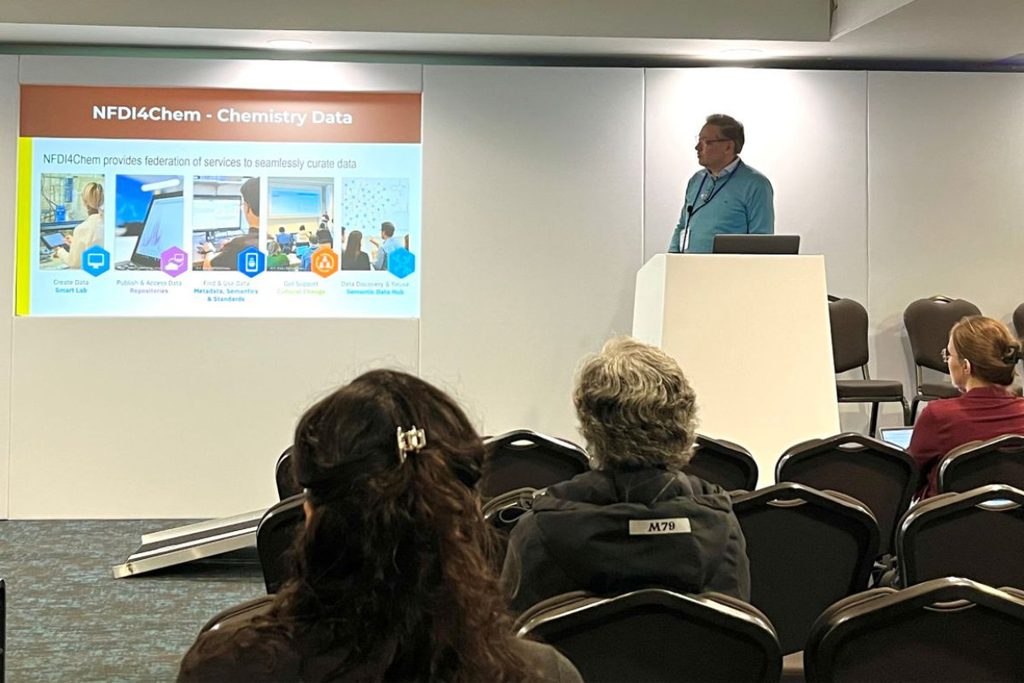
Our co-speaker, Oliver Koepler, presented how research data is curated through a network of coordinated services:
- In the lab: Machine-readable metadata is generated directly in the Chemotion ELN electronic lab notebook.
- Semantic annotation: The metadata is enriched with ontology terms from the Terminology Service.
- Publication: The data is deposited in the network’s repositories, such as the Chemotion Repository, nmrXiv, or RADAR4Chem.
- Search: The NFDI4Chem Search Service harvests these repositories and enables a centralized search across all datasets.
- Knowledge graph: The data is converted to chemDCAT-AP-serialized RDF and fed into the Chemistry Knowledge Graph.
Automation and AI Along the Data Pipeline
Automation and AI support are integrated into several stages of the NFDI4Chem data pipeline. They range from the collection of data from measuring instruments through data conversion, metadata extraction, and enrichment to the AI-assisted assignment of ontology terms in the ELN. Data validation is also part of the process. In the future, it will also be possible to query the knowledge graph using AI agents. In all cases, humans remain involved (“human-in-the-loop”).
Key Takeaways from the Session
The subsequent discussion revealed many points of agreement: For instance, rule-based automation handles the bulk of routine work in many areas. AI is particularly helpful when it highlights to curators what they should look at first. And it was emphasized repeatedly that all of this requires well-curated data and robust standards.
Next Steps
Many participants would like to continue the discussion on the different roles of AI tools in handling research data. The likely next step is the establishment of a working group or task groups within an overarching AI group of the RDA.
Suggested topics include:
- Guardrails for AI agents in research tools
- Provenance of agent actions and human approvals
- A common framework for evaluating AI tools
- An open exchange of scripts and lessons learned
We look forward to continuing our collaboration.