Orthonym is a new open-source tool that generates an IUPAC name from a chemical structure and indicates how reliable that name is. It was developed at the Beilstein Institute and in the research group led by our speaker Christoph Steinbeck (Friedrich Schiller University of Jena) in collaboration with Achim Zielesny (Westphalian University of Applied Sciences). Version 1.0.5 can now also be installed via conda-forge.
________________________________________
Naming a molecule correctly can be a time-consuming process in practice, and automatically generated names are not always reliable. This is where Orthonym comes in: you input a structure, and out comes an IUPAC name with the reliability it truly deserves.
How Orthonym works
- Rule-based rather than AI-generated: Orthonym generates names in accordance with the 2013 IUPAC recommendations, aiming to produce the Preferred IUPAC Name (PIN). No model or sampling is used; therefore, the same structure always receives the same name.
- Verification by reverse parsing: The name parser OPSIN, which never sees the original structure, parses the name back into a structure. If both structures match, the name is considered verified.
- Honest when uncertain: Each name is displayed alongside its reliability rating. If Orthonym is unsure, it declines and states the reason rather than making a guess.
- Explanation function: ‘Explain’ breaks down a name and highlights the atoms described by each part of the name.
- Can also be used in reverse: Conversion from name to structure is also possible via OPSIN.
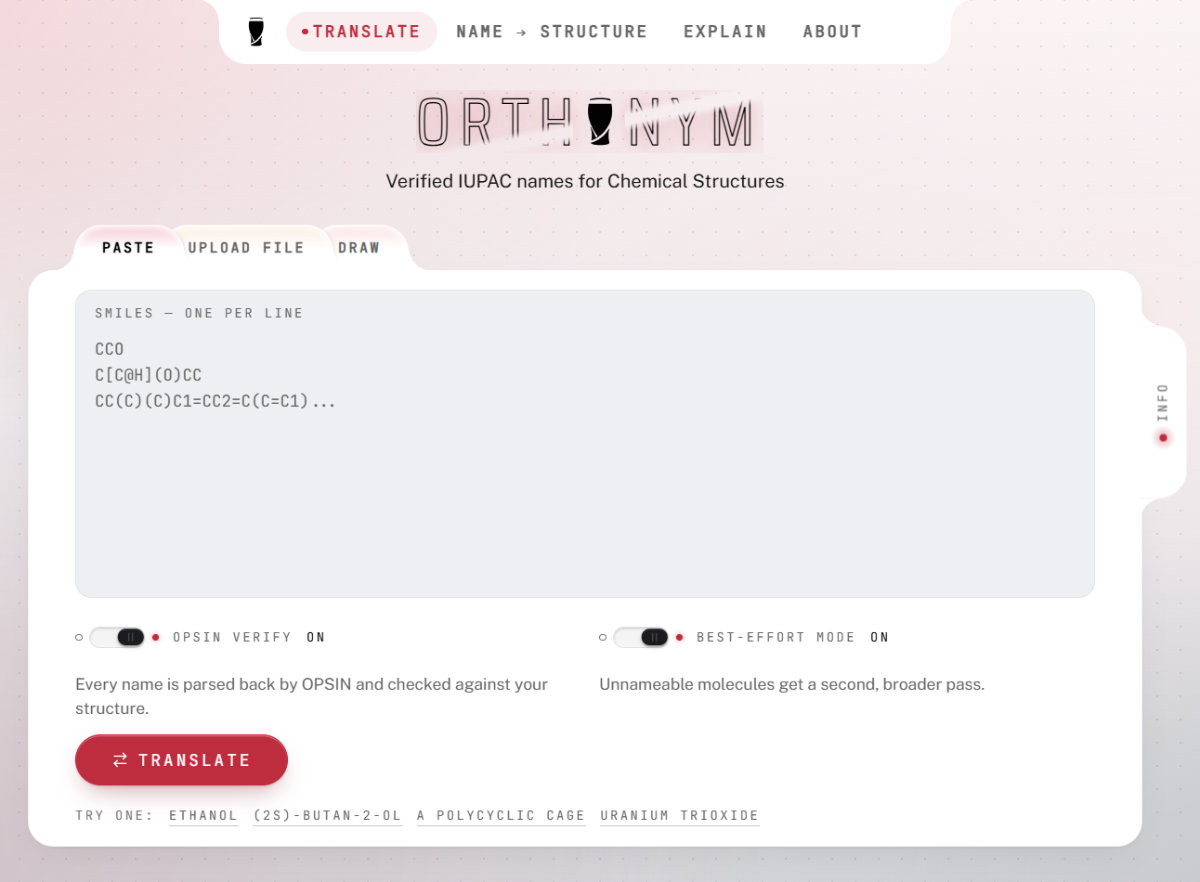
Structures can be pasted, uploaded or drawn in the browser; it is also possible to name many molecules at once. Orthonym can be used free of charge in the browser and is licensed under the MIT licence. It can also be used via the command line or within your own Python code.
New in version 1.0.5
The latest version is available via conda-forge:
conda install -c conda-forge orthonym
Much has improved since version 1.0:
- PIN first: The default level provides only the preferred IUPAC name or rejects it with a reason (NO_VERIFIED_PIN). Further levels provide other correct names, each with a level label. A name only receives the ‘pin_verified’ label after separate spelling checks.
- Spelling according to the ‘Blue Book’: Orthonym uses the 2013 spelling conventions for ‘di’/‘bis’, brackets, isotope notation and the order of prefixes. Indexed hydrogen is added where an ending requires it, and charges and hydrons remain attached to the correct atom.
- Bridged and polycyclic systems: These include bridged fused PINs for all fused parent systems printed in the book, ketones and imides on bridged parent systems, the morphine class and other two-ring fused heterocycles. For von Baeyer and spiro systems, Orthonym provides names, to the best of its ability, for up to 100 ring atoms and 11 rings.
- New bond classes: Small ions, geminal groups, sulphuric acid esters, larger helicenes, nitrate esters, the carbonic acid family, phosphanes and further ureas have been added.
- RDKit integration: The naming functions now accept RDKit molecules as well as SMILES strings.
Try it out and give feedback
The development team invites you to test Orthonym with your own molecules and push it to its limits. If you think a name is incorrect, you can open an issue on GitHub.
Links
- Web app: https://orthonym.decimer.ai/
- Source code (engine): https://github.com/Steinbeck-Lab/Orthonym
- Documentation: https://steinbeck-lab.github.io/Orthonym/