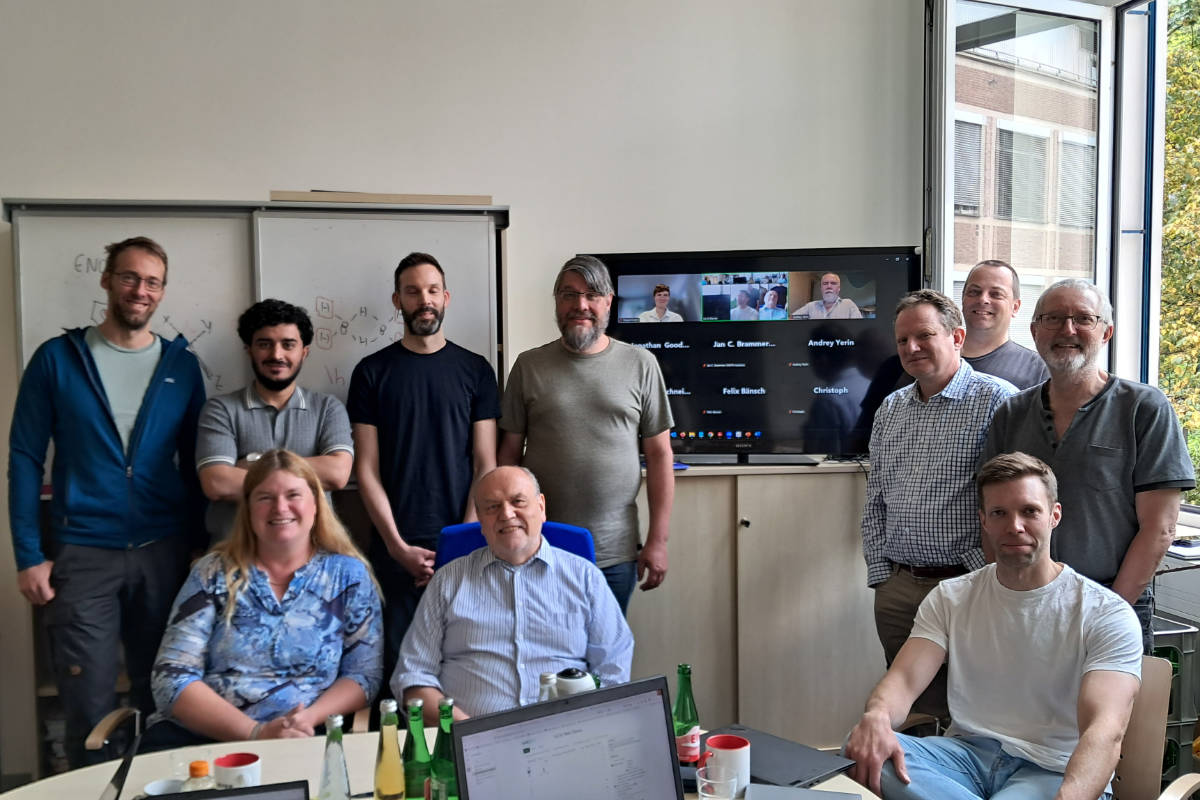
Three days, one big question: How do we make chemical structure information fit for the next generation of chemistry?
At the end of july, we hosted the Technical InChI Meeting at RWTH Aachen University, bringing together members of the InChI community from around the world — both in Aachen and online.
The discussions made one thing very clear: chemical identifiers are becoming increasingly important infrastructure for FAIR data, machine learning and AI in chemistry.
We worked on several exciting developments:
🔹 The future evolution of InChI — including versioning, releases and the beta implementation of new functionality.
🔹 Enhanced stereochemistry — addressing challenging cases where stereochemical information is dependent, pseudochiral or otherwise difficult to capture.
🔹 Inorganic stereochemistry — a particularly fascinating challenge. How can we describe polyhedral coordination environments, spherical coordinates and 2.5D/3D configurations in a robust and machine-readable way? This is essential when the InChI represents the enormous structural diversity of inorganic and organometallic chemistry.
🔹 InChI and AI/ML — we discussed an important long-term vision: InChI is fundamentally an identifier, but its future relevance will depend on how well it can interact with the representations and data structures needed by AI systems.
And perhaps equally important: we discussed how to teach InChI. Correct molecular sketches are key to correct InChIs. This sounds facile but in the inorganic regime, correct drawing may be complicated, especially when dealing with inorganic chiral compounds. Hence, we will work on a series of teaching modules. If chemical identifiers and FAIR data are to become part of everyday chemistry, they cannot remain the domain of specialists. We need accessible teaching materials, examples, videos and resources for students at different levels and in different languages.
The Beilstein team present herefore a new website which visually explains the layers of an InChI: https://cheminfo.beilstein.org/explain-that-inchi/
Give it a try!
What makes these meetings particularly productive is that they bring together very different perspectives: cheminformatics, inorganic chemistry, crystallography, software development, data science and education. That combination is exactly what we need to build digital infrastructure that actually reflects chemistry — including the parts of chemistry that are still difficult to represent computationally.
A big thank you to everyone who contributed, both in Aachen and remotely. Moreover, we thank the VolkswagenStiftung, NDFI4Chem and the Beilstein Stiftung for continuous support.
The future of chemical information infrastructure is being built now – by the InChI Trust and the InChI Team!