The first euroSAMPL <https://gitlab.tu-dortmund.de/kast_ccb/eurosampl/challenge> challenge, organized by Stefan Kast, Ricardo Mata, and Paul Czodrowski, was established to continue the SAMPL (Statistical Assessment of Modeling of Proteins and Ligands) challenge series with a focus on aqueous pKa value prediction combined with a peer evaluation of submissions concerning FAIR criteria as well as reproducibility.
A detailed overview and analysis of results was recently published as “Hot Paper” in the journal Phys. Chem. Chem. Phys. as part of the Themed Collection “The SAMPL Challenges”, including front page cover image.
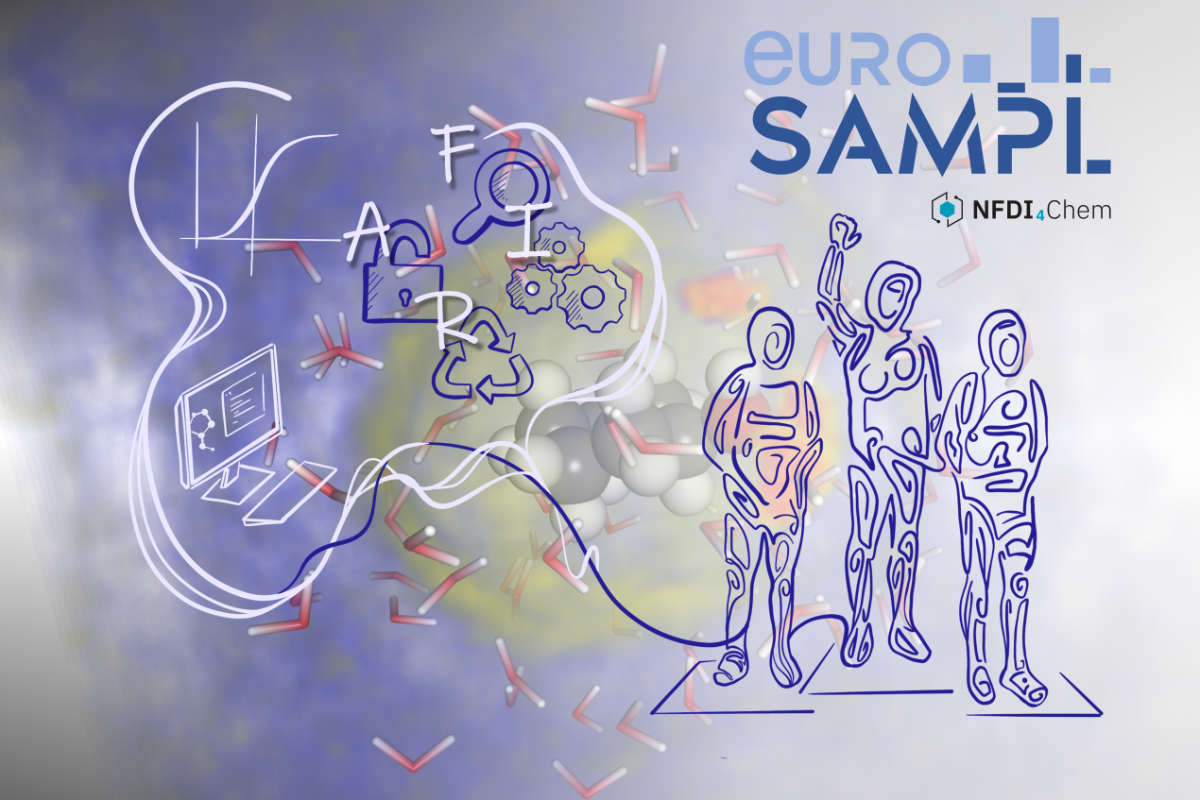
Full reference:
N. Tielker, M. Lim, P. Kibies, J. Gretz, B. Hein-Janke, C. Chodun, R. A. Mata, P. Czodrowski, S. M. Kast, The euroSAMPL1 pKa blind prediction and reproducible research data management challenge, Phys. Chem. Chem. Phys., 2025, 27, 18855-18869.
https://doi.org/10.1039/D5CP01448D
https://doi.org/10.22000/dfqzn3tat216pyzy (RADAR4Chem)
The next euroSAMPL challenge round will open soon, this time on the more involved task of predicting the full set of “micro”-pKa values connecting all 2n microstates of complex molecules with n protonatable groups. Besides allowing for calculations with a wide variety of computational methods the problem encompasses the FAIR documentation of workflows leading to predictions of different experimental observables derived from micro-pKa data such as group-specific pKa values and titration curves.
