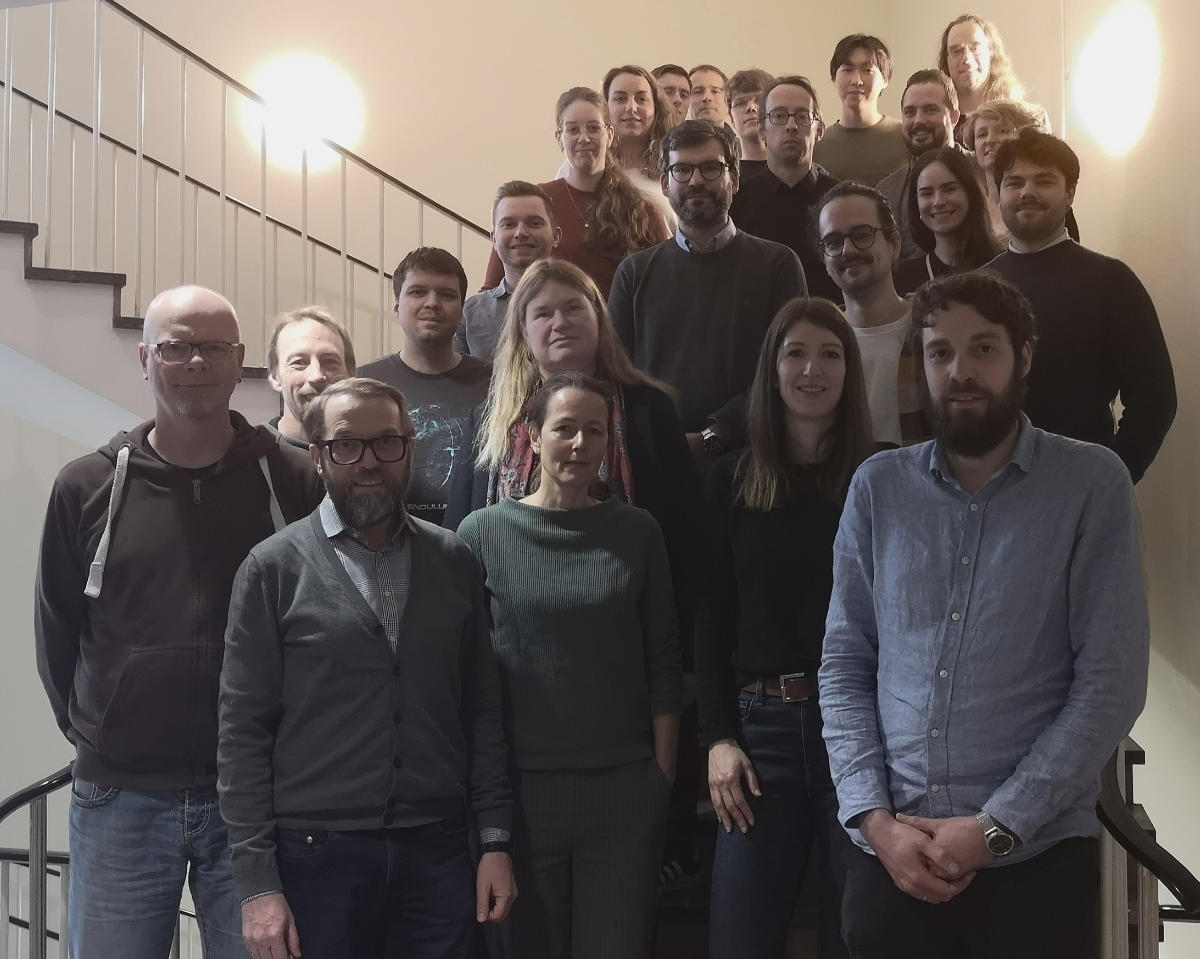
TA5 Retreat Frankfurt, January 2026
On 28 and 29 January 2026, Task Area 5 (TA5 – Community & Training) met for a two-day retreat at the GDCh premises in Frankfurt. The aim of the meeting was to set the strategic direction for the second funding phase, optimise existing offerings and further develop the workflow between subgroups, partners and target groups in research and teaching.
Structure and topics of the retreat
The meeting began with a review of current activities and the definition of future priorities. Slot 1 focused on the structure and objectives of TA5. Several subgroups were merged or dissolved in order to avoid overlaps and pool capacities. A new addition was the Flagship Lab subgroup, which will act as a bridge between best practices and research data management (RDM) in the future. In addition, the next NFDI4Chem surveys were scheduled for winter 2026/27 and 2029/30.
A key topic was the integration of new partners – in particular their role in the further development of training and communication offerings. There was also discussion of how the continuation of NFDI4Chem activities can be structurally anchored after the end of the second funding phase.
Slot 2 focused on internal exchange: How can communication and collaboration between subgroups and partners be made more efficient? It was agreed to hold regular internal TA5 meetings every three months and to introduce short “flash reports” for better preparation. Two focus workshops on Open Educational Resources (OER) and outreach & regulars’ table formats are to provide concrete development impetus in 2026.
Slot 3 was devoted to prioritising the ideas that had emerged, with a focus on outreach and visibility. Plans were made to create new communication formats for under-30s, to explore possible forms of cooperation with teachers and internship supervisors, to develop new OER templates and to increase NFDI4Chem’s presence in generic media.
The second day began with Slot 5 on the integration of RDM into teaching. Here, the vision of comprehensive digitisation in chemistry studies was further concretised. A central goal is the gradual subcurricular integration of RDM content, i.e. its teaching within existing modules. Examples such as the “ELN in the internship” model or cross-module course templates for Moodle and OpenOLAT are to be used more extensively.
Finally, Slot 4 focused on existing and new TA5 offerings. The emphasis was on sustainability, service integration and training structures. A comprehensive plan for the strategic development of TA5 services is planned, to be coordinated by Sonja Herres-Pawlis and Johannes Liermann.
Outlook
The retreat demonstrated how strongly TA5 is now networked within NFDI4Chem and beyond, but also revealed some weaknesses. The participants agreed on clearly focused goals: consolidation of structures, intensive knowledge transfer with new partners, targeted outreach and sustainable anchoring of RDM in chemical education.
The agreed measures should enable TA5 to further expand the bridge between digital infrastructure, practical training and scientific cultural development in the second funding phase.