University-wide introduction of Chemotion ELN
By Theo Bender, Christoph Brüning, Daniel Bellinger, Thomas Schmidpeter, Ulrich Schatzschneider
Summary
In this article, we would like to report on the experiences gained with the introduction of an electronic lab notebook (ELN) at Julius Maximilian University of Würzburg from the perspective of those involved. With the increasing digitisation of research, there is growing pressure on stakeholders to digitise their workflow as well. The introduction of an ELN at an institute or, as in the case of the University of Würzburg, even university-wide, is a complex task whose successful implementation and acceptance by researchers depends on many factors. The approach taken by the University of Würzburg is a prototypical example of a cost-effective and successful introduction of an ELN that could also be implemented at other universities.
Introduction
Anyone who works in a (chemical) laboratory needs to keep records: of preliminary considerations, the experimental setup, measurements and their results, notes, etc. In chemistry, the type of records kept has remained virtually unchanged for centuries: handwritten information in bound laboratory notebooks on paper, often supplemented today by pasted-in images of measurement results. Computers, on the other hand, have become many times faster over the last 40 years. With the digitisation of research, the input, i.e. the creation of information, is already digital, for example as data from analytical instruments such as NMR or mass spectrometers. Output, i.e. publication in scientific journals, is also usually digital. Against this background, a handwritten laboratory journal causes a media discontinuity that requires follow-up work. Typing in measurement data is not only time-consuming, but also prone to errors. Adding manually recorded measurement data to publications is very difficult. Publishing open or even FAIR data (see Wilkinson et al., 2016) is practically impossible in this way. In introducing an ELN with all the advantages it offers (see below), the University of Würzburg is also focusing on the synergy between research and teaching. In this way, teaching benefits from the wealth of experience gained through research, while at the same time laying the foundations of knowledge for students and future researchers on their way to a completely FAIRe and digital laboratory.
ELNs have a number of advantages:
Digital basis: An ELN (Adam et al., 2023) offers the possibility of recording all laboratory activities in a software program, linking them to digital measurement data, and adding metadata for subsequent (data) publication. This provides a basis for digital research data management (RDM) as required by the German Research Foundation (DFG) (Forschungsgemeinschaft, 2022).
Pressure from publishers: Scientific publishers may make the publication of raw data mandatory in the near future (Parks et al., 2023). This has already been the case for X-ray crystal structures for many years: Anyone who does not deposit the underlying data in a recommended repository (e.g. Cambridge Structural Database (Taylor & Wood, 2019)) cannot publish an article with a crystal structure in the journals of the International Union of Crystallography – and many others (Journals, n.d.).
Backup options: Data security in FDM is crucial nowadays. An ELN provides security features because all research data is stored on central servers that can be integrated into backup routines.
Time savings: Creating reports is one of the standard tasks in research: supporting information (SI) in chemistry often runs to 100 pages or more. Those who maintain their data correctly in the ELN can generate the SI with just a few mouse clicks. Nevertheless, only 30% of chemists use an ELN (Ortmeyer et al., 2024). The implementation in Würzburg shows how the successful implementation of an ELN in teaching can look.
Implementation
The introduction of a centrally operated ELN for the Faculty of Chemistry and Pharmacy at the University of Würzburg will begin in 2019, initiated by an exchange at a workshop in Cologne. Ulrich Schatzschneider, Professor of Bioinorganic Chemistry, is made aware of the NFDI4Chem consortium and its goals (NFDI4Chem, n.d.) by Prof. Sonja Herres-Pawlis (RWTH Aachen University), which consist of providing infrastructure and knowledge for research data in chemistry (for the task of the NFDI, see Kraft et al., 2021) A subsequent enquiry to the dean’s office regarding the use of digital tools in the Department of Chemistry and Pharmacy reveals that usage is low. As the university executive committee makes a similar enquiry to the dean’s office at the same time, the urgency of the issue becomes apparent.
Schatzschneider then takes on responsibility for introducing an ELN at the faculty. At this point, individual working groups are using their own software. However, a centralised ELN is more efficient, as administrative tasks such as professional hosting, update and user rights management, and backup only need to be performed once. In addition, the computer centre (RZ) at JMU Würzburg pursues a strategy of offering services across the entire university rather than just for individual departments. The idea of an ELN for his working group becomes a university-wide project. This is also in the interest of the university management, because an existing ELN infrastructure must now be demonstrated for excellence applications or other large collaborative projects.
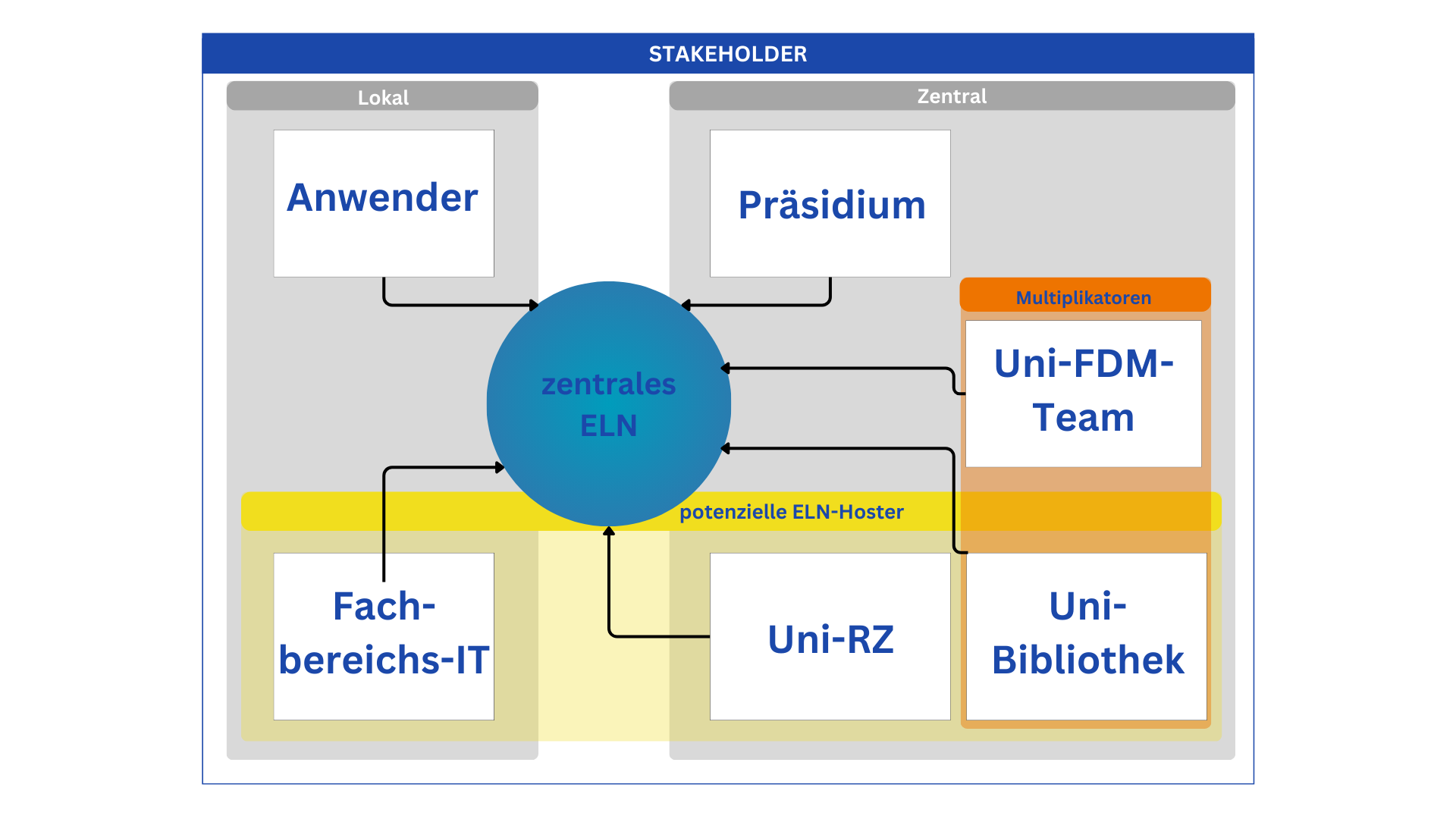
As a result, the circle of those for whom the ELN is potentially relevant is growing. Discussions with central departments such as the university library follow (Figure 1). At that time, a commercial ELN is already being hosted at the computer centre. However, it is not suitable for chemistry, as it does not support searches for chemical structural formulas or structure- or reaction-oriented work, and it also requires a licence. Although the computer centre in Würzburg usually offers only one tool for each task, this does not apply to ELNs. The computer centre recognises the different requirements of various departments, so the new ELN is not intended to replace the existing one, nor can or should all faculties be obliged to use the new ELN.
The ELN guide from ZBMed (Adam & Lindstädt, 2020) and the ELN Finder (https://eln-finder.ulb.tu-darmstadt.de/home) from TU Darmstadt are used to select a suitable ELN. These list 21 ELNs for chemistry. When searching in Würzburg, the open source ELN Chemotion (https://chemotion.net/) emerges as a suitable alternative.
The deciding factors for this are
- Open source, licence-free, no commitment to commercial subscription models,
- a “direct line” to the development team for support, but also integration into active design and development,
- Integration into university infrastructure (user and data management),
- Data security,
- special optimisation for the chemical industry,
- the import interfaces, which can be used to directly import measurement data from many device manufacturers, and
- the simplification of data and article publications.
In regular discussions with all stakeholders from the departments at the Faculty of Chemistry and Pharmacy, the computer centre and the departmental IT department, the expectations of the researchers are coordinated with the performance requirements of the computer centre. One focus is on integrating the ELN into existing tool chains and authentication using Shibboleth (https://www.shibboleth.net/), a single sign-on procedure. User authentication via Shibboleth enables users to use a single ID throughout their entire time at the university and access data across all faculties.
Time horizons
Experience in Würzburg shows that sufficient time must be allowed for negotiations at university level so that responsibilities and cost coverage can be clarified satisfactorily. With regard to data protection and legal compliance, the administrative department from the data centre will be involved in the process relatively early on in 2022–2023. The choice of ELN can also take into account the protection of employees from work monitoring by supervisors. Chemotion enables completely user-centred control: data is only released upon specific approval by the user. Filling a position with the appropriate IT expertise requirements proves to be challenging and takes a long time. Once the newly hired IT employee can take care of the ELN deployment starting in May 2023, things will move quickly. The first test servers will be up and running within four weeks, with official operations commencing at the start of the 2023/24 winter semester. With the growing number of 119 users in March 2025 and demand levelling off, the focus is now shifting to device integration and further customisation options, such as use as a dangerous goods directory, etc. The integration of devices at departmental or group level is supported by the departmental IT department, but is also organised and managed decentrally in the working groups. The first devices and automated workflows will then be ready to launch in 2025, covering everything from measurement to journaling.
Costs
The concept of total cost of ownership has been developed and standardised as a method that attempts to take into account all open and hidden, immediate and future, one-off and ongoing costs of a purchase decision (Weber, n.d.). It was primarily used here to compare the costs of centralised and decentralised installation of one or more ELNs, as listed below. Acquisition, licensing and administrative costs (contract drafting, etc.): With Chemotion ELN, JMU Würzburg has opted for an open source product, which means that these costs are eliminated, as is usual with open source software. Costs for decentralised ELNs: Centralised hosting eliminates decentralised operating costs. Roles and rights are managed in the working groups, so that only a minimal amount of working time is required here. Central operating and personnel costs in the data centre: New software installations are usually installed on “virtual machines”, which are parts of a physical server encapsulated by software. The initial investment is therefore low to negligible. However, with increasing usage, a dedicated server may become necessary. In Würzburg, support requires approximately 0.25 FTE for an administrator position. These costs were covered by the university’s executive committee. The storage requirements in the data centre are negligible in the initial phase, but may become relevant as usage increases. In chemistry, comparatively small amounts of data are generated, but redundant systems and backups increase the space requirements exponentially. Support costs: Not applicable, as Chemotion ELN offers support free of charge. As an in-kind contribution, ELN users at JMU participate in the further development of the software by reporting bugs, suggesting improvements and providing user feedback.
Training courses
Although basic functions are often easy to understand, the efficient use of such a comprehensive tool as an ELN requires thorough training. The NFDI4Chem consortium offers a wide range of training courses for the Chemotion ELN (NFDI4Chem, n.d.). These include basic courses in research data management, beginner and advanced courses for Chemotion ELN, and in-house and online training courses that can be booked individually for every need. Thanks to this range of courses, it was not necessary to develop a comprehensive training concept at the University of Würzburg. Instead, JMU Würzburg is making use of the courses offered by the NFDI4Chem consortium. Shortly before the official launch of the application at the end of September 2023, two trainers from NFDI4Chem will be invited to Würzburg for a two-day workshop, which will be attended by the first 30 users. Further beginner and advanced courses will be planned as needed.
Use in teaching
ELNs offer particular advantages in teaching. Students benefit from the time savings. For progress reports in front of the teacher and the group, transferring data from a paper notebook to a presentation often takes several hours. When using an ELN, students check in their project whether everything has been entered and can present immediately. Lecturers benefit from interactive work on a shared screen, as this allows them to discuss and analyse laboratory data together. In the past, students showed copies of their spectra in meetings, and questions could only be clarified at the next meeting. Today, if something stands out, lecturers and their students open the spectrum editor, zoom in on the data and can immediately discuss what to do. In group seminars, the ELN can be shared on a projector or large screen so that everyone can watch and learn. There are plans to integrate the ELN into the practical courses of the bachelor’s programme in the future, as is already being implemented at RWTH Aachen University (Fink et al., 2023) and RPTU Kaiserslautern. This gives students contact with digital data tools at an early stage of their studies, enabling them to draw on this knowledge for their bachelor’s thesis and then in all subsequent stages.
Conclusion
Anyone who works with digital laboratory data will find it difficult to do without an ELN in the long term. It makes sense to introduce an ELN university-wide. The more centralised the installation, the lower the cost per user. Especially if ELNs have generic functions, they can be used across institutions and even across departments.
Tips for successful implementation
- Allow time.
- Involve all users and stakeholders at an early stage. This includes local FDM teams, university libraries, institute IT departments, university computer centres, and the executive committee.
- Plan total cost of ownership: purchase costs, licences, personnel costs for administration, server costs.
- Consider centralised registration service.
- Use scalable data storage (for increasing usage).
- Plan rights and roles concept early on.
- Develop or purchase a training concept.
- Consider the reusability of data: Can the data sets be transferred, e.g. when changing ELNs? Beware of proprietary formats?
Bibliography
- Adam, B., Bossert, L. C., Cyra, M. A., Grönewald, M., Janosch, S., Knipprath, N.,Lindstädt, B., Schreyer, L., Strauß, F., Timm, H., Valencia-Schneider, M.,Schröder, M., Zerr, S., & Zulauf, B. (2023). Raus aus dem Kladdenchaos: Elektronische Laborbücher als zentrale Dienstleistung – Erfahrungen und Empfehlungen. Bausteine Forschungsdatenmanagement, 5, 2–19.https://doi.org/10.17192/bfdm.2023.5.8553
- Adam, B., & Lindstädt, B. (2020). Elektronische Laborbücher im Kontext von Forschungsdatenmanagement und guter wissenschaftlicher Praxis – ein Wegweiser für die Lebenswissenschaften: ELN-Wegweiser (2. aktualisierte und erweiterte Fassung). ZB MED – Informationszentrum Lebenswissenschaften.https://doi.org/10.4126/FRL01-006422868
- Fink, F., Hoffmann, A., & Herres-Pawlis, S. (2023). Results of a Three-Year Survey on the Implementation of Research Data Management and the Electronic Laboratory Notebook (ELN) Chemotion in an Advanced Inorganic Lab Course. Journal of Chemical Education, 100(11), 4287–4297.https://doi.org/10.1021/acs.jchemed.3c00380
- Forschungsgemeinschaft, D. (2022). Guidelines for Safeguarding Good Research Practice. Code of Conduct. https://doi.org/10.5281/zenodo.6472827
- Journals, I. (n.d.). Data-sharing policy. Zugriff 10. Juli 2025 unter https://journals.iucr.org/services/datasharingpolicy.html
- Kraft, S., Schmalen, A., Seitz-Moskaliuk, H., Sure-Vetter, Y., Knebes, J., Lübke, E., & Wössner, E. (2021). Nationale Forschungsdateninfrastruktur (NFDI) e. V.:Aufbau und Ziele. Bausteine Forschungsdatenmanagement, 2, 1–9. https://doi.org/10.17192/bfdm.2021.2.8332
- NFDI4Chem. (n.d.). Workshops – ein Überblick. Zugriff 10. Juli 2025 unter https://www.nfdi4chem.de/de/workshops/
- Ortmeyer, J., Hausen, D., & Herres-Pawlis, S. (2024). Wo befinden wir uns in derdigitalen Transformation wirklich? Nachrichten aus der Chemie, 72(4), 15–17.https://doi.org/10.1002/nadc.20244142251
- Parks, N. A., Fischer, T. G., Blankenburg, C., Scalfani, V. G., McEwen, L. R.,Herres-Pawlis, S., & Neumann, S. (2023). The current landscape of author guidelines in chemistry through the lens of research data sharing. Pure and Applied Chemistry, 95(49), 439–450. https://doi.org/10.1515/pac-2022-1001
- Taylor, R., & Wood, P. A. (2019). A million crystal structures: The whole is greater than the sum of its parts. Chemical Reviews, 119(16), 9427–9477.https://doi.org/10.1021/acs.chemrev.9b00155
- Weber, J. (n.d.). Total Cost of Ownership. Zugriff 10. Juli 2025 unter https://wirtschaftslexikon.gabler.de/definition/total-cost-ownership-49401/version-272634
- Wilkinson, M. D., Dumontier, M., Aalbersberg, I. J., Appleton, G., Axton, M., Baak, A.,Blomberg, N., Boiten, J.-W., da Silva Santos, L. B., Bourne, P. E., Bouwman, J.,Brookes, A. J., Clark, T., Crosas, M., Dillo, I., Dumon, O., Edmunds, S., Evelo, C. T.,Finkers, R., … Mons, B. (2016). The FAIR Guiding Principles for scientific data management and stewardship. Scientific Data, 3(1).https://doi.org/10.1038/sdata.2016.18
Note: This article first appeared in the “Bausteine Forschungsdatenmanagement” 02/2025, under the DOI https://doi.org/10.17192/bfdm.2025.2.8761
