Report from Meeting in Aachen März 2026
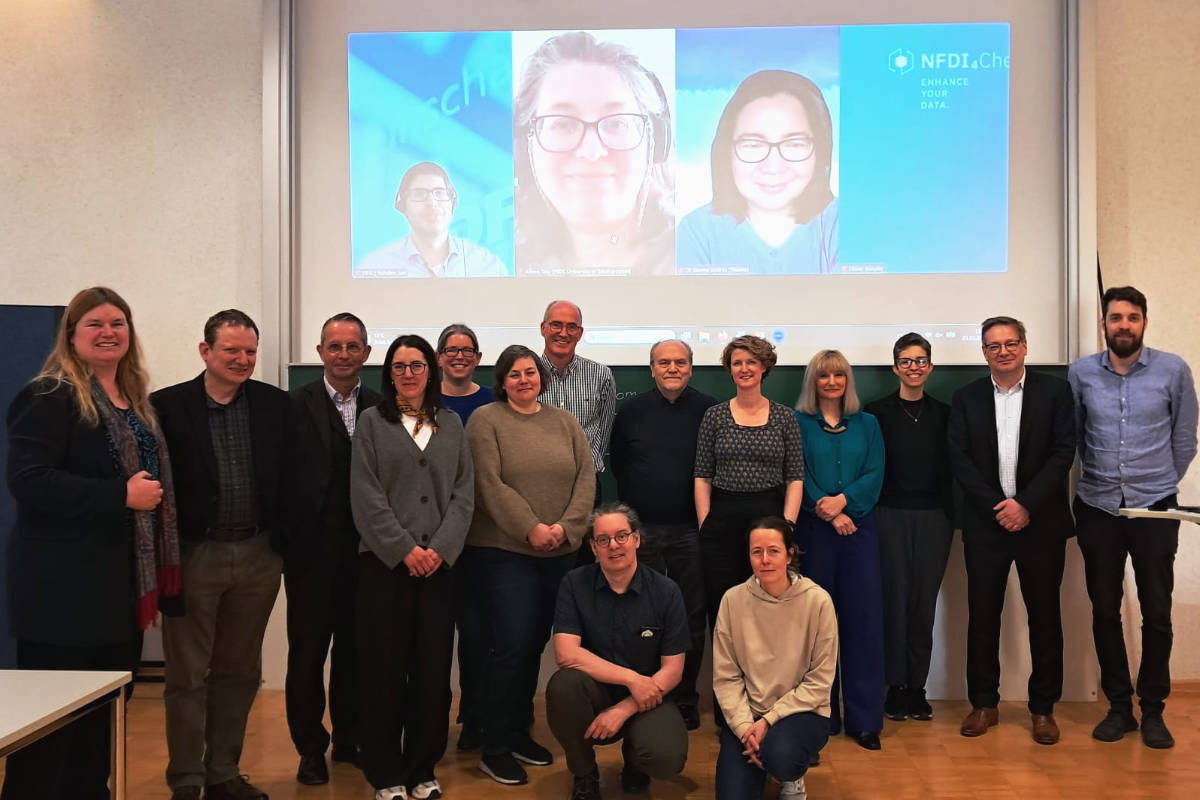
At the 3rd Editors4Chem workshop in Aachen, NFDI4Chem brought together key stakeholders from across the chemical publishing ecosystem, including representatives from IUPAC, CODATA, Physical Sciences Data Infrastructure (PSDI), Royal Society of Chemistry, CCDC – The Cambridge Crystallographic Data Centre, as well as Thieme, Wiley-VCH, Springer Nature, the Beilstein-Institut Institute and the Deutsche Forschungsgemeinschaft (DFG) – German Research Foundation. Over two intensive days, participants discussed how to advance scientific publishing toward a closer and more effective integration of research data.
The discussions made one point particularly clear: although reliable and discipline-specific infrastructures such as Chemotion, MassBank, nmrxiv, and RADAR4Chem were already in place, fewer than 5% of chemistry publications were currently linked to their underlying research data in repositories. The limitation did not lie in technology, but in the way scholarly communication was practiced.
Current state of data publication
Participants examined both the technical and cultural dimensions of this gap. On the first day, the focus lay on the current state of data publication. It became evident that most funders already encouraged or required the deposition of FAIR data, with the DFG highlighting its guidelines on good research practice. At the same time, the benefits of FAIR data for transparency, reproducibility, and reuse were widely acknowledged. However, the group agreed that mandates alone had not been sufficient to drive widespread adoption.
Instead, the discussions emphasized the importance of incentives, visible benefits, and community-driven advocacy. Experience from fields such as crystallography showed that the transition toward routine data deposition had taken more than a decade. While the chemistry community did not have the same amount of time, the underlying pathway appeared similar: sustainable change required a shift in both practices and mindset.
Building on this shared understanding, participants collaboratively worked on a joint memorandum on Open and Responsible Data in Chemistry. This participatory process aimed to define common principles and concrete measures to foster FAIR data publication across stakeholders. The initiative remained open, and additional publishers were explicitly invited to join and contribute.
Technical Workflows
The second day focused on technical workflows that supported authors and reviewers during the publication process. Topics included validation tools and mechanisms to better integrate data submission into editorial procedures. These discussions highlighted that user-oriented solutions would be critical for lowering barriers and embedding FAIR data practices into everyday research workflows.
Conclusions
A broad consensus emerged over the course of the workshop: the technical infrastructure for FAIR data was ready, but a cultural shift was still needed to make data publication standard practice. Achieving this shift would require coordinated efforts across publishers, funders, infrastructure providers, and research communities.
The outcomes of the workshop will feed directly into the finalization of the joint memorandum, marking an important step toward more transparent, interconnected, and responsible chemical research. This dialogue initiated in Aachen will continue at the 4th Editors4Chem workshop in September 2026.
